Water Heaters
Tankless Water Heaters in Union County & Central NJ
Tankless (on-demand) water heater installation and repair, sized for your household's peak hot water use.
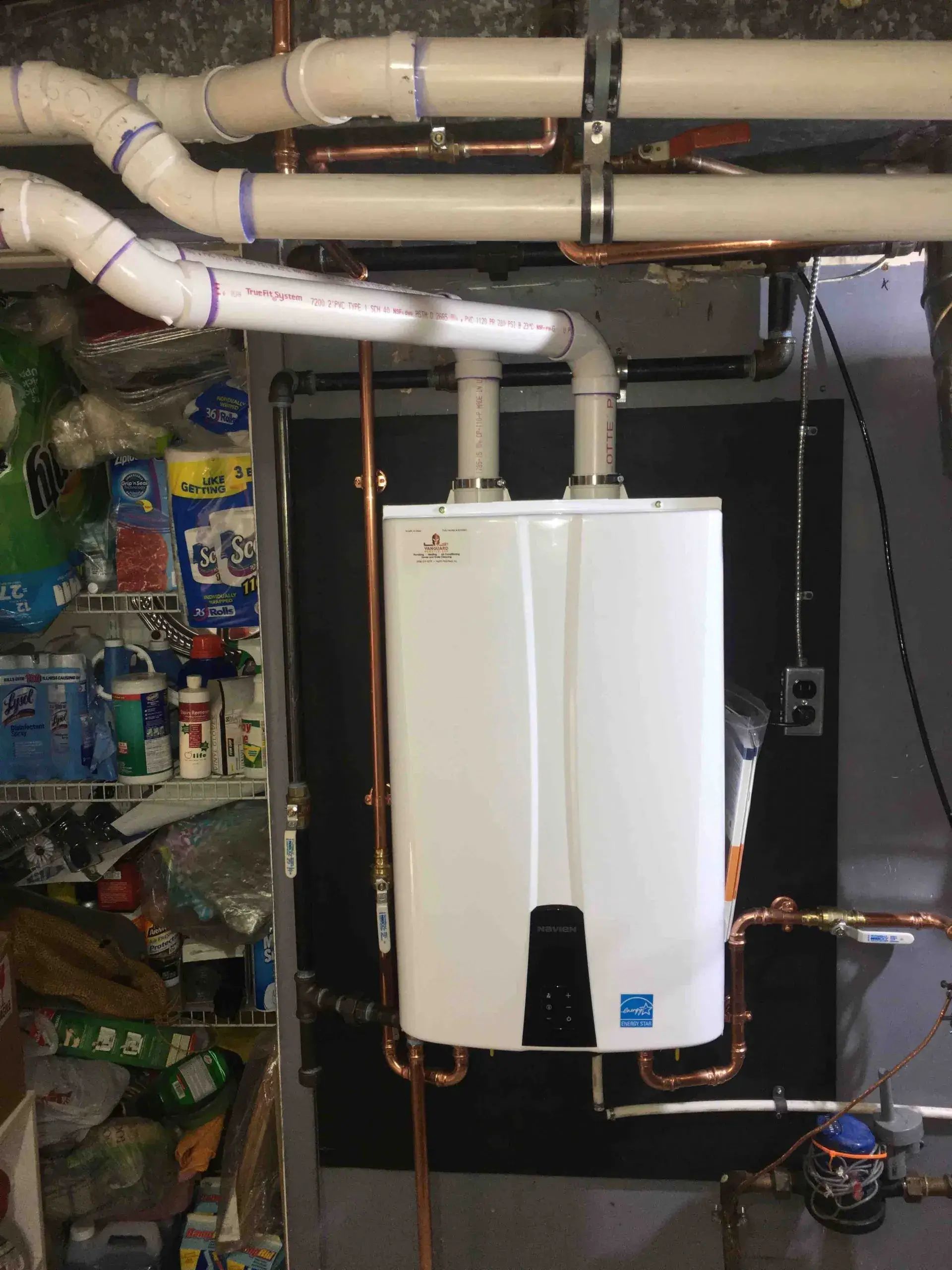
A tankless heater only heats when a tap opens, trading a storage tank for a burner and heat exchanger that have to keep up with every fixture you run at once. We install new units, convert homes from a tank, and repair units that show error codes, swing in temperature or have scaled up. For a new unit, we size it for peak demand in the coldest months and confirm the gas line and venting can support it before recommending it. For an existing one, we start with the unit's error codes and work from there.
Common problems and how we handle them
Why does the water run hot, then cold, then hot again?
That brief cold slug is often called a cold water sandwich. When a tap is shut and reopened within a short time, the hot water left in the pipe comes out first, then the water that sat unheated in the unit while the burner restarted, then fresh hot water. Some of this is normal for tankless systems. If the temperature swings in the middle of a shower instead, the usual suspects are a flow rate below the unit's minimum, a dirty inlet filter, or scale on the heat exchanger.
Why can't my tankless heater keep up with two showers in winter?
Output depends on how many degrees the water has to be raised. Incoming water is colder in winter, so the same unit delivers fewer gallons per minute at shower temperature in January than in August. A heater that seemed fine when it went in during warm weather can fall behind once the ground cools. The answer may be staggering simultaneous use, adding a second unit, or, when the unit is starved for gas, correcting the supply piping so it can reach its full firing rate.
My tankless unit shows a code and will not fire. What can I check?
A few causes can be ruled out without opening the unit. See whether your other gas appliances, such as the range, are working, since a heater that is short of gas will not light. Look outside where the vent and air intake leave the house for drifted snow, blown leaves or a nest across either opening. On a condensing model, check that the condensate line to the drain is not kinked, clogged or frozen in a cold space. Past that, leave the cover on. Many units keep a record of recent fault codes that the technician can pull up to see whether the problem is new or has been building.
Can my house switch from a tank to tankless?
Often, but it takes more than swapping one box for another. A gas tankless unit needs a much larger gas input than most tank heaters, which can mean a bigger gas line from the meter. It needs its own vent run, commonly out a side wall rather than into the old chimney, and condensing models need a drain for acidic condensate. We look at all three before quoting, because together they decide whether the conversion is practical in your home.
How the job works
- List the fixtures your household runs at the same time and work out the flow rate and temperature rise the unit must handle in the coldest months.
- Trace the gas piping from the meter to the planned location and check that its size and length can deliver the unit's full rated input.
- Plan the vent route and termination clearances, plus a condensate drain for a condensing model, with a neutralizer where one is needed.
- Fit isolation valves on the water connections so the heat exchanger can be descaled later without cutting pipe.
- On a repair visit, pull the stored error codes, clean the inlet filter, check the flame sensor and gas pressure, and flush the heat exchanger if scale is restricting flow.
- Fire the unit at high demand to confirm it reaches temperature and holds it with several fixtures open.
Cost of tankless water heater installation & repair
Tankless pricing turns on the gas piping and venting as much as on the heater. A conversion that needs a larger gas line and a new vent through a wall is a bigger project than swapping one tankless unit for another in the same spot. Unit capacity and whether a condensing model fits also matter. We put the full scope and price in writing, and nothing is installed until you sign off on it.
Why homeowners call Vanguard for tankless water heater installation & repair
- Licensed and insured. We work under NJ Master Plumber license NJMPL 13344 and HVACR license 19HC00609600, and every job is done by our own technicians, never a subcontractor.
- Upfront pricing, free estimates on most jobs. You approve a written price before work begins. No surprise line items when the job is finished.
- 4.9 stars across 556+ Google reviews. Read what customers say.
- Answered 24/7. Our phone is answered around the clock, including holidays.
Related water heater services
Areas we serve
We provide tankless water heater installation & repair throughout Union, Middlesex, Somerset, and Essex counties, including:
Tankless Water Heater Installation & Repair questions
How often does a tankless water heater need descaling?
It depends on water hardness and how much hot water the house uses. Minerals build up inside the heat exchanger, and many manufacturers call for a flush about once a year, sooner in hard water. Some units display a scale warning when it is due. A flush circulates a descaling solution through the exchanger using the service valves, which makes it a routine job when those valves are in place.
Do tankless heaters really give endless hot water?
They keep making hot water as long as demand stays within the unit's flow rating, so a long shower will not empty anything. What they cannot do is exceed that rating. Open more fixtures than the unit can heat for and the water cools or the unit restricts flow. Sizing for your real peak use, not the average, is what makes the endless part true.
Condensing or non-condensing: which tankless unit should I pick?
Condensing units pull extra heat from the exhaust, so they use less gas for the same hot water and can usually vent with plastic pipe. They also produce acidic condensate that needs a drain. Non-condensing units skip the drain but need stainless steel venting built for hotter exhaust. The right choice depends on where the unit goes, how the vent can run, and whether a drain is nearby.
Will a tankless heater work when the power goes out?
A gas tankless unit still needs electricity for its controls, fan and igniter, so it stops heating water while the power is out. A tank heater with a standing pilot keeps working through an outage. If outages are a concern where you live, weigh that before converting, or plan a backup power source for the unit.
Ready to Get It Fixed?
Call or email us. We'll get back to you fast.